

Table of Contents
- What 'Fresh' Actually Means for Roasted Coffee
- Coffee Roast Date vs Best By Date: Which One to Trust
- How Long Does Coffee Stay Fresh After Roasting
- Signs of Stale Coffee Beans You Shouldn't Ignore
- Is Subscription Coffee Really Fresh, or Just Convenient?
- Packaging That Protects Freshness: One-Way Valves and Nitrogen-Flushed Bags
- How to Store Coffee Beans for Maximum Freshness at Home
- What to Look for in a Subscription Coffee Service
Last Updated: August 13, 2026
What 'Fresh' Actually Means for Roasted Coffee
Freshness in roasted coffee is the window between degassing and staling. Immediately after roasting, beans release carbon dioxide and develop their flavor profile. Too early, and the coffee tastes sharp and underdeveloped. Too late, and oxidation has stripped away the volatile aromatics that make specialty-grade coffee worth drinking.
Most consumers assume fresh means "recently purchased." In reality, freshness depends on roast date, storage conditions, and how quickly the bean reaches your grinder. A bag sitting in a warehouse for six weeks is not fresh, regardless of what the label says.
Volatile Aromatics, Oxidation, and Why They Matter
The sensory experience of great coffee comes almost entirely from volatile aromatic compounds that evaporate quickly when exposed to oxygen, heat, or light. According to research published by the Specialty Coffee Association, coffee contains hundreds of these compounds, many of which degrade within days of roasting once the bag is opened.
Oxidation is the primary culprit. When oxygen contacts the oils on roasted beans, it breaks down the lipids responsible for body and sweetness, producing a flat, cardboard-like cup. This is why airtight packaging and proper storage matter as much as the roast itself.
The Science of Degassing After Roasting
Freshly roasted coffee is not immediately ready to brew. Degassing, the process by which roasted beans release trapped CO2, lasts 12 hours to several days depending on roast level. Light roasts degas more slowly; dark roasts degas faster. Brewing too soon produces uneven, sour-tasting extraction.
The ideal brewing window for most whole bean coffees is 4 to 14 days post-roast: after degassing stabilizes but before oxidation meaningfully degrades quality. Subscription services that roast to order and ship within 24 to 48 hours hit this window almost perfectly, provided transit time is reasonable.
Coffee Roast Date vs Best By Date: Which One to Trust
Trust the roast date. Always.
A best by date tells you almost nothing useful about coffee freshness. It's typically calculated backward from a marketing-driven shelf life estimate, not from any scientific measurement of the bean's actual condition. Many commercial roasters set best by dates 12 to 18 months after roasting.
The coffee roast date is the only number that tells you where you are in the freshness window. With that date, you can calculate exactly how much time has passed and whether you're approaching the staling threshold.
If a bag doesn't display a roast date, only a best by date, that signals the roaster isn't confident enough in their freshness to advertise it. The specialty coffee industry has largely self-regulated around roast date transparency, and the best operators treat it as non-negotiable.
How Long Does Coffee Stay Fresh After Roasting
Coffee stays meaningfully fresh for 2 to 4 weeks after roasting under good storage conditions. After that, flavor degradation becomes noticeable to most drinkers. Coffee doesn't suddenly become undrinkable at day 29, but the nuance and complexity that justify paying more for specialty-grade beans fade steadily from the moment roasting ends.
Whole Bean vs Pre-Ground Shelf Life
Whole beans retain freshness for 2 to 4 weeks post-roast in a sealed, airtight container. The outer structure acts as a natural barrier against oxidation.
Pre-ground coffee begins losing volatile aromatics within 15 to 30 minutes of grinding. The dramatic increase in surface area exposes far more of the bean to oxygen simultaneously. Most pre-ground coffee purchased in stores was ground weeks or months before you opened the bag.
If you're using a subscription service and choosing pre-ground for convenience, understand the trade-off: you're accepting meaningfully accelerated flavor degradation. For most specialty-grade coffees, that's worth reconsidering.
Signs of Stale Coffee Beans You Shouldn't Ignore
Stale coffee announces itself clearly once you know what to look for:
- No aroma when you open the bag. Fresh beans smell intensely of coffee even before brewing. Stale beans smell like almost nothing or faintly of cardboard.
- Flat, oily surface on dark roasts. A thick, rancid-smelling slick indicates oxidized lipids.
- No bloom during pour-over. When hot water hits fresh grounds, CO2 causes a visible bloom. No bloom means the coffee is old.
- Dull, bitter, or papery taste. Staling introduces bad flavors alongside removing good ones.
- Beans that look faded or dusty. Fresh roasted beans have a slight sheen. Stale beans look matte and dull.
Before adjusting your grind size or water temperature, check your roast date.
Is Subscription Coffee Really Fresh, or Just Convenient?
A subscription model, in theory, is the best possible delivery system for fresh coffee. Beans roast on a schedule, ship immediately, and arrive within days. No warehouse, no retail shelf, no guessing about how long that bag has been sitting under fluorescent lights.
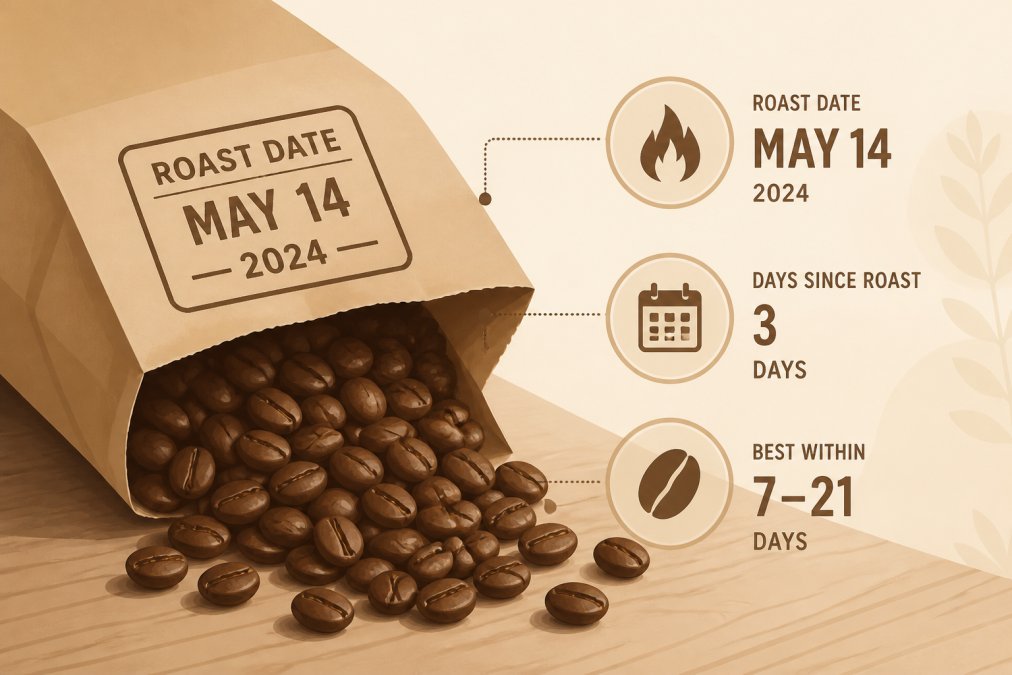
In practice, many subscription services have scaled by pre-roasting in bulk, pulling from existing inventory rather than roasting per order. The subscription model becomes a billing mechanism, not a freshness guarantee. The coffee ships on a schedule, but the roast date might be two or three weeks old before it leaves the facility.
The question to ask any subscription service is direct: do you roast to order, or do you roast to inventory? The answer tells you everything.
Christ Coffee roasts from real orders rather than warehouse stock, which means your beans go into the roaster after you place your order. Combined with shipping that typically arrives 5 to 7 days after roasting, the coffee reaches your door inside the ideal brewing window.
How Shipping Transit Time Affects Flavor
Shipping transit time is the hidden variable most subscription reviews ignore entirely. A roaster can do everything right and still deliver a degraded product if transit takes too long. Five days from roast to doorstep is excellent. Ten days is acceptable. Fourteen days is the outer edge of the ideal window.
Nitrogen-flushed bags and one-way valve packaging slow oxidation during transit, but they don't stop it. When evaluating any subscription service, ask for average transit times to your region, not just roast-to-ship times.
Subscription Coffee vs Buying Local: An Honest Comparison
Buying from a local roastery has one genuine advantage: you can ask when the beans were roasted and have them in your hand within minutes.
But local access to specialty-grade, freshly roasted coffee varies dramatically. Many areas have no quality local roaster within a reasonable distance. Even where local options exist, selection may be limited, roast dates inconsistent, or pricing higher than direct-to-consumer subscription.
Subscription coffee wins on repeatability and curation. When a service roasts to order and ships fast, you get consistent freshness without remembering to stop somewhere. The curated selection also exposes you to beans you'd never find locally.
| Factor | Local Roastery | Subscription (roast-to-order) | Subscription (inventory-based) |
|---|---|---|---|
| Roast date transparency | High | High | Often unclear |
| Time from roast to cup | Same day possible | 5-10 days typical | 2-6 weeks typical |
| Selection variety | Limited to local | Curated, broader | Varies widely |
| Convenience | Requires travel | Delivered to door | Delivered to door |
| Freshness consistency | Variable | High | Low to moderate |
| Cost | Often premium | Competitive | Competitive |
Packaging That Protects Freshness: One-Way Valves and Nitrogen-Flushed Bags
Packaging is a functional component of the freshness chain, not just a marketing detail.
One-way valves allow CO2 from degassing to escape without letting oxygen in. Without this valve, a sealed bag would inflate and burst. With it, beans degas naturally while remaining protected from oxidation.
Nitrogen-flushed bags replace the oxygen inside packaging with inert nitrogen before sealing. Nitrogen doesn't react with coffee compounds, so beans experience essentially zero oxidation during storage and transit. According to research on coffee packaging and shelf life from the Journal of Food Science, nitrogen flushing combined with one-way valve technology significantly extends shelf life compared to standard sealed packaging.
Avoid any bag without a one-way valve. If the packaging has no valve, the roaster either waited weeks for the coffee to fully degas before packaging or the bag is designed for short shelf life.
How to Store Coffee Beans for Maximum Freshness at Home
Good storage requires understanding what damages coffee and removing those variables. The four enemies are oxygen, moisture, light, and heat.
Best practices for home storage:
- Store in an airtight container, not the original bag once opened
- Keep the container away from direct sunlight; a cabinet or pantry is ideal
- Avoid storing near the stove or any heat source
- Do not refrigerate whole beans; moisture and odor absorption damage flavor
- Freezing is acceptable for long-term storage of unopened bags, but only freeze once
- Buy in quantities you'll consume within two to three weeks of opening
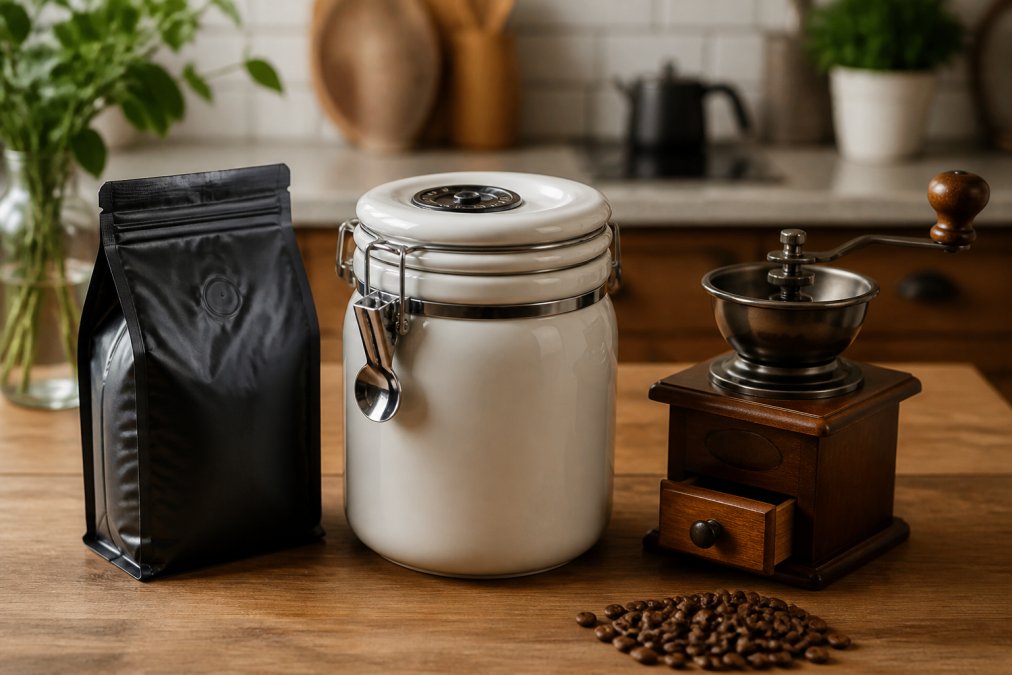
Storing coffee in a clear glass jar on the counter exposes beans to both light and temperature fluctuations, accelerating staling noticeably. Opaque, airtight, room-temperature storage is correct.
What to Look for in a Subscription Coffee Service
Not all subscriptions are built the same. This checklist separates services that genuinely prioritize freshness from those using the subscription model purely for recurring revenue.
Freshness indicators:
- Roast date printed on every bag (not just best by date)
- Explicit roast-to-order policy, not inventory fulfillment
- Shipping timeline stated in days from roast, not days from order
- One-way valve and nitrogen-flushed or airtight packaging
Transparency indicators:
- Clear information about supply chain and sourcing
- Batch roasting details or single-origin traceability
- Honest communication about quality standards
Flexibility indicators:
- Adjustable delivery frequency to match your consumption
- Easy skip or pause options without penalty
- Satisfaction guarantee with real recourse
Mission alignment (for values-driven buyers):
- Verifiable charitable partnerships with documented impact
- Transparent breakdown of where purchase dollars go
- Third-party partner accountability
Christ Coffee checks each of these boxes. The satisfaction guarantee includes no-questions-asked replacement, the roast-to-order model is central to operations, and charitable partnerships with Destiny Rescue, A21, Love146, and the Tim Tebow Foundation are documented and verifiable. According to the Specialty Coffee Association's consumer research on purchasing drivers, transparency in sourcing and roasting practices has become a primary decision factor for specialty coffee buyers.
Is subscription coffee really fresh? Yes, when the service is built around freshness rather than convenience as its primary value. The mechanics of batch roasting, one-way valve packaging, and fast shipping can deliver coffee that arrives in better condition than anything you'd pull off a grocery store shelf. The distinction is whether a given service actually operates that way, or just says it does.
Christ Coffee was built on the roast-to-order model specifically because freshness and mission can't coexist with warehouse inventory. When you shop, you're getting beans roasted for your order, shipped within days, with a satisfaction guarantee behind every bag.
Frequently Asked Questions
How long does coffee stay fresh after roasting?
Whole bean coffee hits peak flavor roughly 4 to 14 days after roasting, once degassing slows. From there, beans remain enjoyable for 3 to 4 weeks when stored in an airtight container away from heat and light. Pre-ground coffee stales much faster, within days, because grinding dramatically increases surface area exposed to oxygen. A subscription coffee service that roasts to order and ships within days of roasting gives you the best shot at catching beans inside that peak window.
Does shipping time affect coffee bean freshness?
Yes, but less than most people assume, provided the beans are packaged correctly. Coffee shipped in nitrogen-flushed bags with one-way valves can handle 5 to 7 days in transit without meaningful flavor degradation, because the valve releases CO2 from degassing while blocking oxygen from entering. The bigger risk is when roasters pre-roast large batches and hold them in a warehouse before shipping. Roasted-to-order services eliminate that delay entirely, so transit time becomes the only variable affecting freshness.
Is a coffee subscription worth it for freshness compared to buying at a store?
For most home brewers, a subscription coffee service delivers fresher beans than retail grocery options. Bags on store shelves often carry a 'best by' date 6 to 12 months from roasting, with no roast date listed. By the time you buy and brew, the coffee may already be 2 to 4 months old. A roasted-to-order subscription ships beans days after roasting, putting you well inside the peak flavor window. The trade-off is planning ahead, you need to time deliveries so you don't run out between shipments.
What is the freshest coffee you can buy?
The freshest coffee comes from a roaster who roasts your specific order on demand, then ships immediately. Look for a clearly printed roast date on the bag, not just a best-by date, and aim to brew whole bean coffee within 2 to 4 weeks of that date. Subscription services that roast to order, rather than pulling from pre-roasted warehouse stock, consistently outperform both retail bags and subscription services that batch-roast in advance.
This article was written using GrandRanker