

Table of Contents
- Why Coffee Roast Date Importance Cannot Be Overstated
- Visual Signs That Tell You If Coffee Is Freshly Roasted
- The Coffee Bloom Test: Your Most Reliable Freshness Check
- Aroma and Taste: Sensory Indicators of Freshly Roasted Coffee
- How Roast Level Affects Freshness Perception
- How to Store Coffee Beans for Freshness After Purchase
- Troubleshooting Home-Roasted Beans
- Conclusion
Last Updated: August 14, 2026
Why Coffee Roast Date Importance Cannot Be Overstated
The roast date printed on a bag of specialty coffee is the single most important number on the package. Coffee is a perishable food that begins releasing carbon dioxide and absorbing oxygen immediately after roasting, a process called oxidation that steadily degrades flavor, aroma, and body. A bag roasted three months ago is already stale by specialty coffee standards, regardless of the "best by date."
Degassing is the process by which freshly roasted coffee releases CO2 that built up during roasting. Beans still actively degassing are fresh; beans that have exhausted their CO2 are not. Comparing a cup brewed from week-old beans against one from beans roasted two months prior reveals the difference immediately: the fresh cup has brightness, acidity, and layered flavor, while the stale cup tastes flat, papery, or hollow.
Most specialty roasters recommend brewing coffee within two to four weeks of the roast date for peak flavor. According to the Specialty Coffee Association's brewing standards, freshness is a defining quality standard in specialty coffee evaluation. This is why roast-to-order models exist: to close the gap between roasting and your morning cup.
Visual Signs That Tell You If Coffee Is Freshly Roasted
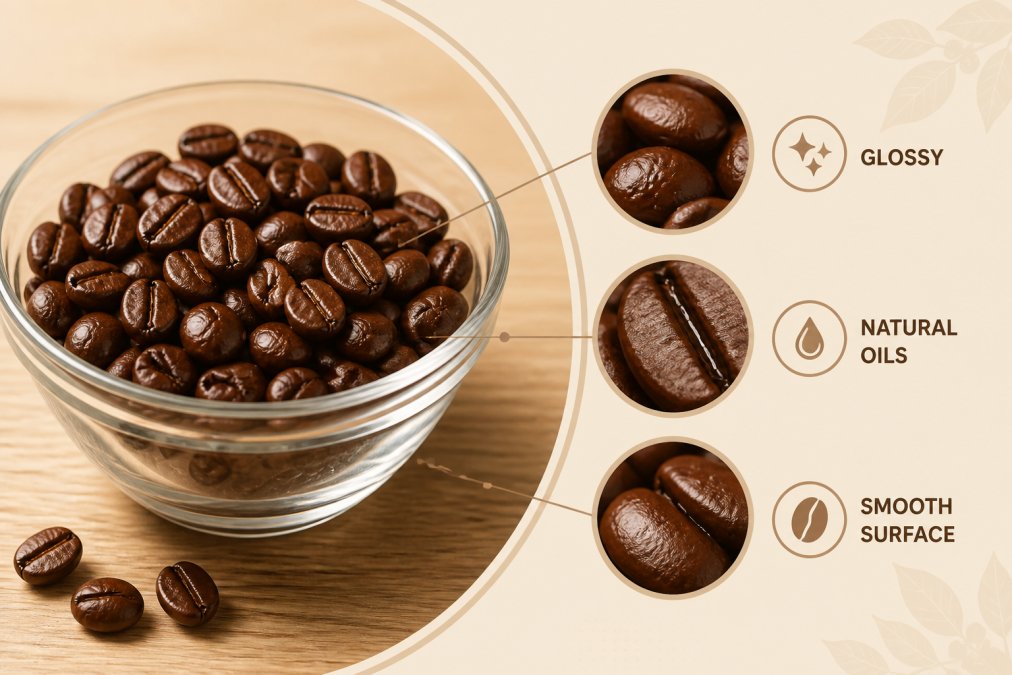
Fresh coffee beans carry a natural sheen from oils that migrate to the surface during and after roasting. In beans roasted within the past week or two, you will see subtle glossiness, particularly on medium and dark roasts. Beans that look completely matte and dry with a dusty appearance have likely lost their surface oils through oxidation and age.
Color consistency also matters. Fresh beans from a single-origin roast should be uniform in color. Significant variation can indicate uneven roasting or poor quality control.
Bean Surface and Oil Migration
Look closely at the bean surface under good light. Fresh light and medium roasts appear relatively dry with faint natural luster. Fresh dark roasts show visible surface oil that looks fresh and even, not thick, sticky, and rancid-smelling. A common mistake is assuming oily beans are always fresher, roast level matters. A light roast that looks oily has likely been sitting a long time, while a dark roast with moderate surface oil is probably in its prime window.
Packaging Clues: One-Way Valves and Puffed Bags
A one-way valve, a small round or oval vent on the bag, allows CO2 from freshly roasted beans to escape without letting oxygen in. If a bag has no valve, the coffee was either roasted long ago or the roaster is not prioritizing freshness.
A puffed bag is a strong freshness signal. When a sealed bag feels firm and slightly inflated, CO2 is building up from active degassing. Press it gently, if it pushes back, the beans are almost certainly fresh. A flat, deflated bag suggests the gas has escaped along with much of the flavor.
Always prioritize bags showing a specific roast date over a "best by date" or "manufacturing date." If no roast date is visible, that absence itself is information.
The Coffee Bloom Test: Your Most Reliable Freshness Check
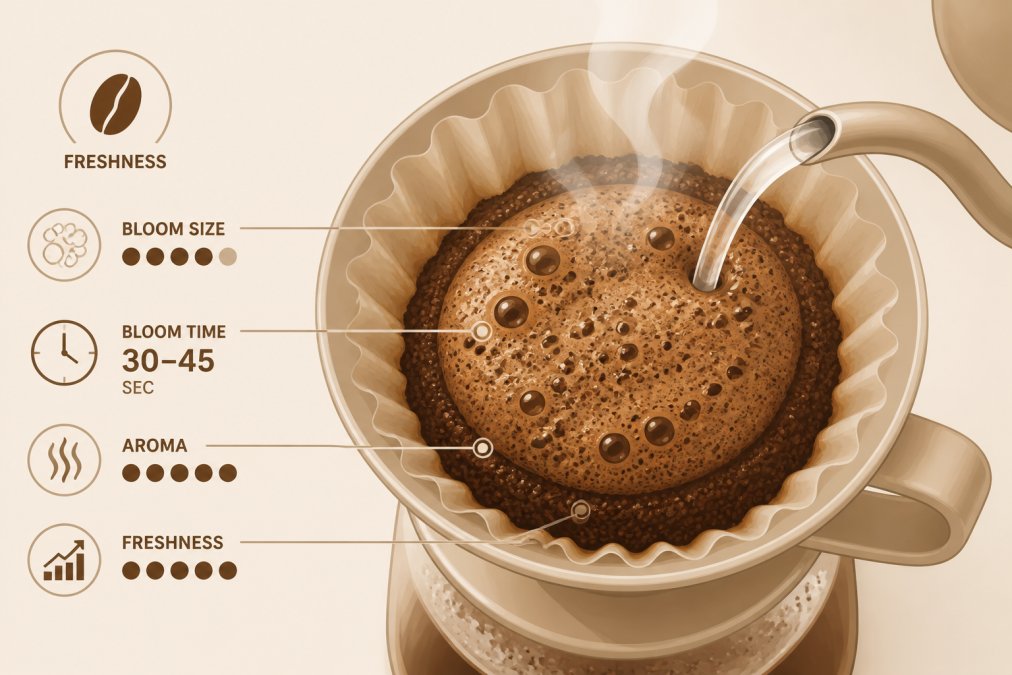
The coffee bloom test is the most definitive freshness check available to a home brewer. Bloom is the rapid release of CO2 when hot water first contacts freshly roasted coffee grounds, appearing as a foamy, bubbling dome. A lively bloom is direct evidence that CO2 remains in the beans, meaning the coffee is fresh. No bloom or a dull response means the CO2 has already escaped.
How to Perform the Bloom Test Step by Step
- Grind your beans fresh. Use your normal grind setting. Pre-ground coffee loses CO2 far faster than whole beans.
- Bring water to brewing temperature. Between 195°F and 205°F for most specialty coffee.
- Add grounds to your filter or dripper. Use your standard dose, typically around 1 gram of coffee per 15-17 milliliters of water.
- Pour just enough water to saturate the grounds. Use roughly twice the weight of water to coffee.
- Stop pouring and observe for 30-45 seconds. Watch the surface carefully.
- Assess the response. Fresh coffee bubbles, swells, and forms a dome. A lively, foamy bloom that holds its shape for 30+ seconds indicates fresh coffee. A modest bloom that quickly collapses suggests drinkable but past-peak coffee. No visible bloom indicates stale coffee.
What the Bloom Tells You About CO2 and Degassing
During roasting, organic material breaks down and produces carbon dioxide, which gets trapped in the bean's cellular structure. After roasting, CO2 slowly escapes through degassing, a process that continues for days or weeks depending on roast level and storage.
When hot water contacts the grounds, it triggers rapid CO2 release, the bloom you see. This gas physically pushes water away from the grounds, which is why most brewing guides recommend a 30-45 second bloom pause before continuing to pour. Fresh coffee needs this pause for proper extraction. Stale coffee does not bloom, and skipping the pause makes little difference.
According to the National Coffee Association's brewing guidelines, proper extraction depends on consistent water contact with grounds, and CO2 interference can affect cup quality.
Aroma and Taste: Sensory Indicators of Freshly Roasted Coffee
Open the bag and smell it before brewing. Fresh coffee smells complex with layers, fruit, chocolate, caramel, floral notes, or nuts depending on origin and roast. The aroma should hit you immediately and fill the room.
Stale coffee smells one-dimensional and muted, often described as cardboard or papery. If you must bury your nose in the bag to detect anything, the coffee is past its prime.
In the cup, fresh coffee tastes bright and layered with pleasant acidity and full body. Flavors evolve as the cup cools. Stale coffee tastes flat from the first sip with dull bitterness, thin body, and short papery finish.
How Roast Level Affects Freshness Perception
Roast level changes how quickly coffee stales and how freshness presents itself.
Light roasts are denser and degas slowly. They reach peak flavor seven to fourteen days after roasting as CO2 settles and delicate flavor compounds stabilize. Brewing too soon can produce a flat, underdeveloped cup because CO2 still interferes with extraction, a phenomenon called being "too fresh."
Dark roasts are porous and degas quickly. They reach peak flavor within two to four days but stale faster. Surface oils oxidize quickly, so dark roast beans go rancid-smelling faster than light roasts. A dark roast smelling musty or sharp rather than rich and chocolatey has almost certainly oxidized.
Medium roasts fall between these extremes, hitting their peak window around five to ten days after roasting and holding it for two to three weeks under proper storage.
| Roast Level | Peak Flavor Window | Degasses | Stales |
|---|---|---|---|
| Light | 7-14 days post-roast | Slowly | Slowly |
| Medium | 5-10 days post-roast | Moderately | Moderately |
| Dark | 2-4 days post-roast | Quickly | Quickly |
A light roast tasting flat on day three might not be stale, it might simply need more time to degas.
How to Store Coffee Beans for Freshness After Purchase
Proper storage separates a two-week peak window from a two-day one. The enemies of freshness are oxygen, moisture, light, and heat.
The best storage solution is an airtight container in a cool, dark pantry or cabinet. Ceramic or opaque containers with tight-sealing lids outperform clear glass jars, which allow light exposure to degrade flavor compounds. Avoid storing coffee above the stove or near heat sources.
Practical storage rules:
- Do not refrigerate whole beans. Refrigerators introduce moisture and absorb surrounding odors.
- Freezing is acceptable for long-term storage only. Portion beans into airtight bags, freeze once, and thaw only what you need. Never refreeze.
- Buy in smaller quantities more frequently. A 250-gram bag consumed within two weeks always tastes better than a 1-kilogram bag taking two months to finish.
- Keep beans whole until brewing. Grinding dramatically accelerates degassing and oxidation.
As documented in food science research on coffee oxidation, oxygen exposure is the primary driver of flavor degradation in roasted coffee, making airtight storage non-negotiable.
Roast-to-order models have a structural advantage: beans arrive at your door typically within five to seven days of roasting, so you start the clock from day one, not day thirty.
Troubleshooting Home-Roasted Beans
Home roasting creates specific freshness challenges that commercial guides rarely address.
The most common problem is brewing too soon. Home roasters are eager to taste results immediately, but freshly roasted beans need at least 12 to 24 hours of degassing before brewing, and light roasts benefit from waiting 48 to 72 hours. Brewing within the first few hours produces a flat, grassy, or underdeveloped cup.
How to tell if home-roasted coffee is ready to brew:
- Smell test at 12 hours. If beans still smell sharp, smoky, or raw, wait longer. Ready beans smell sweet and developed.
- Check for active degassing. Place beans in a sealed jar for a few hours. If the lid bows outward or pressurizes when opened, CO2 is still releasing actively. The beans need more rest.
- Run the bloom test. If the bloom is so vigorous it overflows the dripper, the beans are too fresh for optimal extraction. Wait 24 more hours.
- Assess grind consistency. Very fresh home-roasted beans can be difficult to grind evenly because CO2 makes them slightly compressible.
Home-roasted beans stale faster than commercially roasted beans because home roasters typically lack nitrogen-flushing equipment. Store them in an airtight container immediately after cooling and plan to use them within two weeks.
According to the Roasters Guild's home roasting resources, resting time after roasting is one of the most commonly skipped steps among new home roasters and has measurable impact on cup quality.
Knowing how to tell if coffee is freshly roasted comes down to building reliable habits: check the roast date, observe the packaging, run the bloom test, and trust your nose. These four steps take less than two minutes and will change how you evaluate every bag of coffee you buy.
Stale coffee is one of the most common and preventable problems in home brewing. Christ Coffee was built specifically to close the gap between roasting and your morning cup, roasting from real orders rather than warehouse stock and shipping within days of roasting. With a satisfaction guarantee, a quick quiz for personalized recommendations, and every order contributing directly to the fight against child exploitation through partners like Destiny Rescue and A21, it is a straightforward choice for anyone who wants fresh, specialty-grade coffee with a purpose behind it. Shop Christ Coffee and start your next bag from day one.
Frequently Asked Questions
What counts as freshly roasted coffee?
Freshly roasted coffee is generally considered to be within 2 to 4 weeks of its roast date. During this window, the beans still contain significant carbon dioxide from the roasting process, which preserves aroma and produces a strong bloom when brewed. After about 30 days, oxidation accelerates and flavor compounds degrade noticeably. For espresso, many roasters recommend waiting 5 to 10 days post-roast before brewing, since excess CO2 can interfere with extraction.
How can you tell if coffee beans are fresh without a roast date?
Without a roast date, use three checks. First, perform the bloom test: pour a small amount of hot water over the grounds and watch for a foamy, lively rise. Flat or absent bloom signals stale beans. Second, smell the dry grounds: fresh coffee has a sharp, layered aroma, while stale coffee smells dull, papery, or faintly like cardboard. Third, examine the bean surface under light. Freshly roasted coffee often shows a slight sheen from natural oils migrating outward.
Does the smell of coffee indicate how fresh it is?
Yes, aroma is one of the clearest freshness indicators. Freshly roasted coffee releases volatile aromatic compounds that produce a complex, vibrant smell with notes matching its flavor profile, whether fruity, nutty, or chocolatey. As beans age, those compounds dissipate through oxidation, leaving a flat, papery, or hollow scent. If your coffee smells faintly musty or like an empty paper bag rather than the roasted bean itself, it has likely passed its peak flavor window.
How long after roasting is coffee at its peak flavor?
Most specialty roasters place peak flavor between 7 and 21 days after the roast date, though this varies by roast level and brewing method. Light roasts tend to peak slightly later and hold their acidity longer, while dark roasts peak earlier and fade faster. For drip coffee and pour-over, beans in the 7 to 14 day range typically deliver the best extraction. For espresso, waiting at least 5 to 10 days allows enough CO2 to degas for a balanced, consistent shot.
This article was written using GrandRanker