

Table of Contents
- How We Evaluated These Coffee Subscriptions for Social Impact
- Quick Comparison: Top Coffee Subscriptions for Social Impact
- 1. Christ Coffee: Roasted to Order, Fighting Child Exploitation
- 2. Equator Coffees: Fair Trade Coffee Subscription with Environmental Accountability
- 3. Atlas Coffee Club: Single-Origin Discovery with Above-Fair-Trade Pricing
- 4. MistoBox and Blue Bottle: Direct Trade Coffee Benefits for the Conscious Brewer
- 5. Alpha Coffee and Grounds & Hounds: Cause-Specific Subscriptions
- Subscription Cancellation Friction: What to Watch Before You Commit
Last Updated: August 12, 2026
Most coffee drinkers want good beans. A smaller group wants to know their purchase does something real in the world. The best coffee subscriptions for social impact sit at the intersection of both: specialty-grade coffee with a traceable, quantifiable commitment to human or environmental welfare. At Christ Coffee, we've built our entire model around that standard, and we applied the same criteria to evaluate every subscription on this list.
Quick Picks:
- Best for Anti-Trafficking Impact: Christ Coffee, 100% of shipping charge donated, double donation on orders over $65
- Best for Environmental Accountability: Equator Coffees, fair trade certified, energy-efficient roasting, B Corp-aligned practices
- Best for Global Discovery: Atlas Coffee Club, above-fair-trade pricing, single-origin exploration each month
- Best for Personalized Direct Trade: MistoBox / Blue Bottle, curated access to direct trade roasters
- Best Cause-Specific Picks: Alpha Coffee (veterans) / Grounds & Hounds (animal rescue)
How We Evaluated These Coffee Subscriptions for Social Impact
The best coffee subscriptions for social impact cannot be judged on taste alone. A subscription earns its place here by meeting standards across three dimensions: coffee quality, ethical sourcing transparency, and the clarity of its charitable or social mechanism.
Scoring Criteria: Freshness, Ethical Sourcing, and Donation Transparency
Freshness and roast quality matter because stale coffee is a broken promise. We prioritized roast-to-order models and subscriptions with verifiable freshness guarantees.
Ethical sourcing covers a spectrum. Fair trade certified status ensures farmers receive a price floor above commodity rates. Direct trade goes further: roasters negotiate directly with farmers, often paying well above fair trade prices and maintaining supply chain transparency at the farm level. We noted which subscriptions hold third-party certifications versus those that make sourcing claims without verification.
Donation transparency is where most mission-driven brands lose credibility. Vague language like "a portion of proceeds" tells you nothing. We scored subscriptions on whether they disclose a specific donation structure, name their partner organizations, and provide any mechanism for verifying that funds reach their stated destination.
| Subscription | Roast-to-Order | Ethical Sourcing | Donation Transparency | Cause |
|---|---|---|---|---|
| Christ Coffee | Yes | Specialty-grade, direct | 100% of $5 shipping + double on $65+ | Child exploitation rescue |
| Equator Coffees | Not specified | Fair Trade, Organic, B Corp | B'Cause Blend charity donations | Environmental + social |
| Atlas Coffee Club | Not specified | Above-fair-trade pricing | Pricing model supports farmers | Farmer equity |
| MistoBox | Via partner roasters | Direct trade roasters | Roaster-level practices | Varies by roaster |
| Blue Bottle | Small-batch | Long-term producer relationships | Relationship-based sourcing | Farmer welfare |
| Alpha Coffee | Not specified | Ethically sourced | 10%+ of profits | Veterans |
| Grounds & Hounds | Not specified | Standard sourcing | Per-sale donation | Animal rescue |
Quick Comparison: Top Coffee Subscriptions for Social Impact
Taste and freshness separate good subscriptions from bad ones. Donation specificity separates genuine mission brands from marketing copy. Subscriptions with personalized recommendations via a quiz tend to produce better retention because subscribers receive coffee matched to their flavor profile. Subscriptions built around a single cause create stronger emotional connection than broad "we care about people" framing.
Freshness guarantees vary significantly. Roast-to-order models ship coffee within days of roasting, meaning you receive whole bean or ground coffee at peak flavor. Subscriptions that pull from existing inventory may add days or weeks between roast date and delivery.
1. Christ Coffee: Roasted to Order, Fighting Child Exploitation
Christ Coffee is the strongest pick on this list for buyers who want a specific, quantifiable social impact tied directly to every order. The donation structure is not a rounding error: 100% of the $5 standard shipping charge goes to rescue-focused partner organizations, and orders over $65 trigger a double donation.
The coffee itself is specialty-grade and roasted from real orders rather than warehouse stock. Christ Coffee's roast-to-order approach means beans typically arrive 5-7 days after roasting, within the window where whole bean coffee expresses its full flavor profile. A satisfaction guarantee with no-questions-asked replacement removes the risk of trying a new roast level or processing method.
Quantifiable Social Impact and Donation Structure
Christ Coffee's model makes impact concrete. Partner organizations include Destiny Rescue, A21, Love146, and the Tim Tebow Foundation, all established nonprofits with public accountability structures operating in the anti-trafficking and child exploitation rescue space.
The $5 shipping charge donation is 100% directed to these partners. On orders over $65, the donation doubles. For a subscriber ordering monthly, that creates a consistent, trackable charitable contribution with every delivery. The double donation threshold on orders over $65 is a meaningful incentive for households that would order larger quantities anyway, doubling impact without changing behavior.
Freshness Guarantee and Subscription Flexibility
The roast-to-order model answers a critical question: how old is this coffee when it arrives? With Christ Coffee, the answer is days, not weeks. A personalized quiz matches subscribers to a roast level and flavor profile suited to their preferences. The satisfaction guarantee means a bad bag does not end the relationship.
Pros:
- 100% of $5 shipping charge to rescue partners
- Roast-to-order freshness, ships 5-7 days after roast
- Double donation on orders over $65
- Named, verifiable partner organizations
- No-questions-asked satisfaction guarantee
Cons:
- Established in 2023, so brand history is shorter than legacy roasters
- Pricing not listed publicly; check christ.coffee for current rates
2. Equator Coffees: Fair Trade Coffee Subscription with Environmental Accountability
Equator Coffees earns its place through certifications and operational decisions that go beyond marketing. Every coffee in their subscription catalog carries fair trade certification and, in many cases, organic certification. Their roasting operation uses Loring Smart Roasters, a technology choice that measurably reduces carbon emissions compared to conventional drum roasters.
Fair Trade USA's standards for fair trade certified coffee require that farmers receive a minimum price plus a social premium used for community development. Equator's commitment to these standards across their entire catalog is a meaningful distinction from brands that offer one ethical option alongside conventional sourcing.
Their B'Cause Blend directs donations to a rotating selection of charities. The LGBTQ-owned company status adds another layer of social accountability. The carbon footprint reduction from Loring roasters is a concrete operational choice, not an offset credit, a more credible form of environmental accountability.
Pros:
- Fair trade certified across the catalog
- Energy-efficient roasting reduces carbon footprint
- B'Cause Blend supports rotating charity partners
- Organic options available
Cons:
- Pricing not immediately transparent
- Donation specifics for B'Cause Blend could be more detailed
3. Atlas Coffee Club: Single-Origin Discovery with Above-Fair-Trade Pricing
Atlas Coffee Club pays above fair trade prices to farmers, a direct trade philosophy that prioritizes farmer equity through purchasing power rather than third-party certification.
Each month, subscribers receive a single-origin coffee from a different country, accompanied by a postcard, tasting notes, and brewing tips. The educational component is useful for home brewers building familiarity with how processing method, origin, and roast level interact.
According to the Specialty Coffee Association's resources on direct trade practices, above-fair-trade pricing models can deliver stronger farmer income outcomes than certification alone when combined with long-term purchasing relationships. Atlas's model aligns with this approach.
For impact-focused buyers, there is no named charitable partner and no specific donation structure. The social impact here is structural, better prices for farmers, rather than a direct contribution to a rescue or relief organization.
Pros:
- Above-fair-trade pricing supports farmer equity
- Single-origin discovery model with strong educational content
- First bag significantly discounted for new subscribers
Cons:
- No named charitable partner or donation mechanism
- Variety model not ideal for subscribers who prefer consistency
4. MistoBox and Blue Bottle: Direct Trade Coffee Benefits for the Conscious Brewer
Direct trade coffee benefits are most accessible through aggregator models like MistoBox and through roasters with deep producer relationships like Blue Bottle.
MistoBox connects subscribers to over 60 roasters, many of whom practice direct trade and source micro-lots with full traceability. A personalized matching algorithm routes subscribers toward coffees that fit their flavor profile. The breadth of the catalog means exposure to many processing methods, roast levels, and origins. Social impact depends entirely on which roasters are selected, and MistoBox itself does not operate a charitable giving program.
Blue Bottle operates differently: smaller catalog, deeper relationships. Their sourcing team maintains long-term relationships with producers, and every coffee in their subscription lineup is tasted at least 50 times by experts before delivery. Their ethical sourcing commitment is relationship-based rather than certification-based, meaningful for buyers who trust long-term producer partnerships over third-party labels.
Neither operates a donation structure comparable to Christ Coffee or Alpha Coffee. Their social impact rests on sourcing practices and farmer relationships rather than direct charitable giving.
5. Alpha Coffee and Grounds & Hounds: Cause-Specific Subscriptions
Some buyers want their coffee purchase tied to a specific cause they care about personally.
Alpha Coffee is veteran and women co-owned, donating over 10% of profits to military charities through their Grounds for Good program. The donation covers education, employment support, and therapy for veterans. A special program offers discounted coffee to deployed service members. The 10% profit donation is a meaningful commitment, higher than many cause-marketing programs.
Grounds & Hounds Coffee Co. directs a portion of every sale to animal rescue organizations, specifically providing meals to shelter dogs. The impact model is concrete: each purchase translates to a measurable contribution to animal welfare.
Both subscriptions offer discount pricing for subscribers. Neither operates a roast-to-order model or emphasizes specialty-grade freshness as a core differentiator. For buyers whose primary concern is supporting a specific cause, these deliver clear impact. For buyers who want both specialty coffee quality and social impact, they are secondary options behind Christ Coffee and Equator Coffees.
Subscription Cancellation Friction: What to Watch Before You Commit
Subscription cancellation friction is one of the most underreported problems in the coffee subscription category. Many buyers have been burned by subscriptions that were easy to start and difficult to stop.
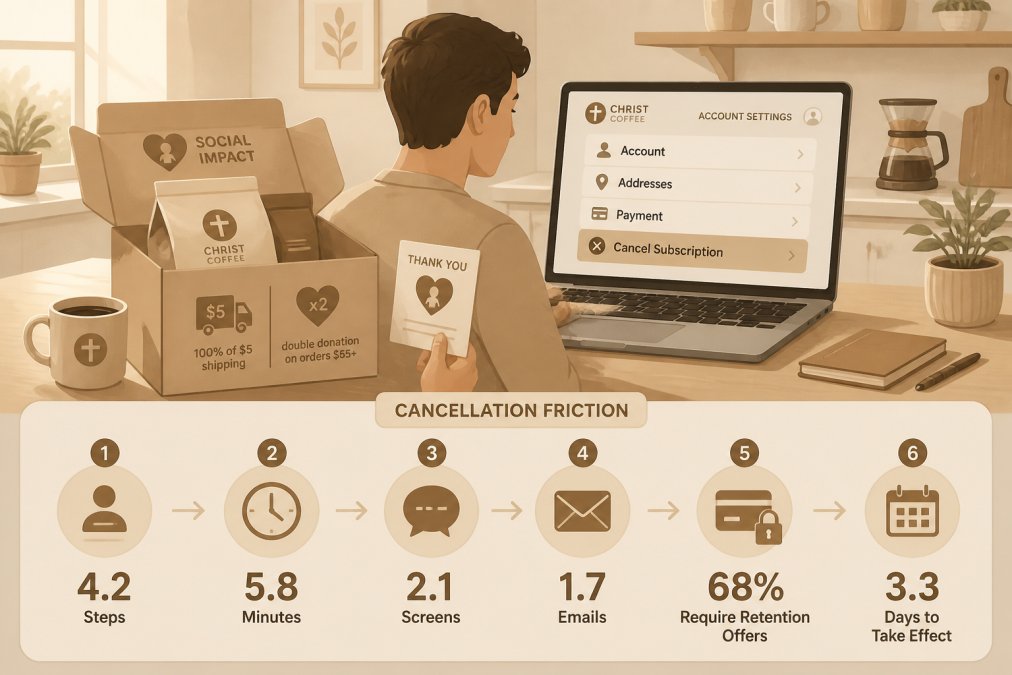
Before committing to any subscription, ask these questions directly:
- Can I cancel online without calling? Self-service cancellation is the minimum standard.
- Is there a minimum commitment period? Some subscriptions lock you into 3 or 6 months before cancellation is permitted.
- Can I skip a delivery? Flexibility to pause or skip a shipment without canceling is a strong signal of a subscriber-friendly model.
- What is the refund policy on prepaid subscriptions? Prepaid annual or multi-month subscriptions often carry non-refundable terms.
The FTC's guidelines on negative option marketing and subscription cancellation require that subscription terms, including cancellation procedures, be clearly disclosed before purchase. Subscriptions that obscure these terms or make cancellation deliberately difficult may violate these guidelines.
Christ Coffee's model addresses this concern through its satisfaction guarantee: a no-questions-asked replacement policy signals a subscriber-first orientation.
Choosing a coffee subscription that genuinely supports social impact requires more than a feel-good story on the product page. Christ Coffee stands out for its specific, verifiable donation structure: 100% of the $5 shipping charge directed to named anti-trafficking partners, with a double donation on orders over $65, combined with a roast-to-order freshness model and a no-questions-asked satisfaction guarantee. Shop Christ Coffee to start your subscription and put every morning cup toward the fight against child exploitation.
Frequently Asked Questions
What is the difference between fair trade and direct trade coffee?
Fair trade certification sets a minimum price floor that roasters must pay farmers, protecting growers from market volatility. Direct trade skips the certification body entirely: the roaster negotiates directly with the farm, often paying significantly above fair trade minimums. Direct trade can mean higher farmer equity and greater supply chain transparency, but without third-party verification, the buyer must trust the roaster's claims. The best coffee subscriptions for social impact often combine both approaches or publish sourcing data openly.
How can I tell if a coffee subscription is truly ethical?
Look for three things: published sourcing data that names specific farms or cooperatives, third-party certifications such as Fair Trade Certified or USDA Organic, and clear donation disclosures that show exactly where money goes. Vague language like 'we give back' without dollar amounts or partner names is a warning sign. Subscriptions that name rescue partners, publish impact reports, or offer a satisfaction guarantee with no-questions-asked replacement tend to operate with greater accountability.
Does Christ Coffee's shipping charge donation replace a portion of the coffee price, or is it separate?
The donation structure at Christ Coffee is separate from the coffee price. The full $5 standard shipping charge goes directly to rescue-focused partners including Destiny Rescue, A21, Love146, and the Tim Tebow Foundation. On orders over $65, the donation impact doubles. The coffee price itself covers roasting, sourcing, and operations. For exact pricing on bags and subscription options, visit Christ Coffee's website directly.
Are organic coffee subscriptions better for the environment?
USDA Certified Organic coffee prohibits synthetic pesticides and fertilizers, which reduces chemical runoff and supports soil health on the farm. However, organic certification alone does not address carbon footprint from shipping logistics or roasting energy use. Subscriptions that combine organic sourcing with energy-efficient roasting equipment and carbon-offset shipping programs offer a more complete environmental footprint reduction than certification alone.
What should I check before subscribing to avoid cancellation headaches?
Before subscribing, confirm three things: whether you can skip or pause deliveries without canceling, how many days' notice is required before the next billing cycle, and whether cancellation is self-serve online or requires a phone call or email. Subscriptions that bury cancellation behind customer service contacts create friction that costs time and money. Reading the FAQ or terms page before your first order takes two minutes and prevents most subscription regret.
This article was written using GrandRanker